Workshop on Intervening in Nature II
Sept. 26-28, 2025 | Flathead Lake | University of Montana Biological Station
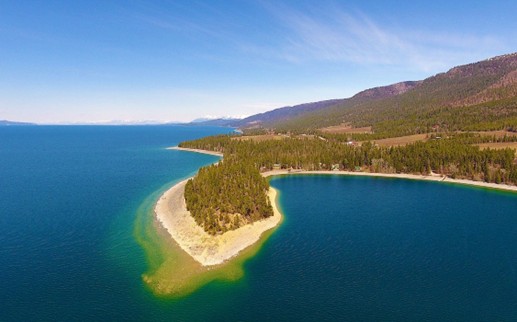
Supported by the Institute for Practical Ethics at UC San Diego and the University of Montana, and organized by Karen Kovaka, Soazig LeBihan, and Craig Callender, this workshop digs into under-explored topics in environmental philosophy. By doing it as a small group, we hope to catalyze future research.
Topic 1: Disinformation and Environmental Conservation
 Environmental issues have been central to the emergence of scholarship on disinformation. Since at least the mid-twentieth century, scientists have reported the harmful environmental consequences of pesticides, industrial pollutants, and greenhouse gases. Fearing the financial impacts of these discoveries, powerful corporate actors have worked to undermine the science using an array of disinformation techniques that by this point have been well-documented.
But even though many of the key cases for the development of disinformation studies have to do with the environment, there has been little exploration of the relationship between disinformation and the science, policy, and ethics of contemporary environmental conservation. Of course, environmental conservation is intimately connected to other environmental issues like climate change and pollution, but it has a different emphasis: on preserving and managing places, habitats, species, and other forms of biodiversity.
Philosophical work on environmental conservation is most often conceptual (e.g. What is biodiversity?) or normative (e.g. What aspects of biodiversity should we conserve?). What happens if we ask about the effects of disinformation on the project of environmental conservation, especially on its scientific research agenda and its policy implementation?
Topic 2: Philosophy of Human-Nonhuman Animal Communication
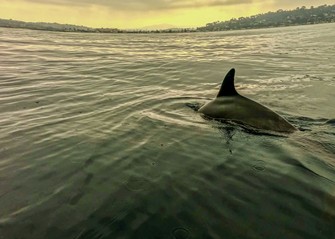 The possibility of communicating with animals has been part of fiction for as long as there have been stories. It has also been a topic of scientific study, in one form or other, for a very long time. In an infamous NASA-funded experiment in the 1960’s, for instance, scientists lived with three dolphin in a converted half-water house in an effort to communicate with dolphin. And in the early 1970’s, the chimpanzee Nim Chimpsky lived with humans in a study that taught Nim human sign language. Perhaps both experiments are cautionary tales of human-nonhuman communication. Now, presumably without the use of drugs but with the use of AI, scientists have made progress studying animal vocalizations.
Large research projects (e.g., CETI) have been devoted to studying dolphins, whales, gibbons, African elephants, marmoset monkeys, crows, wolves, coyotes, domestic dogs, and more. Research has a variety of goals, ranging from developing ID systems to warn boats of nearby whales, to establishing two-way communication. In 2025, the first Coller Dolittle Prize was awarded. The Prize, inspired by the Turing test, “calls on the scientific community to develop an algorithm for communication with non-human organisms.”
Topic 3: Human/Wildlife Conflict
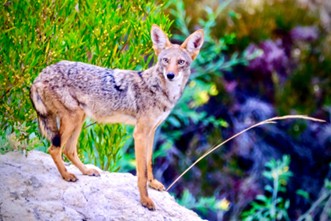 Increasing interactions between humans and wildlife threaten the health of ecosystems and the well-being of people worldwide. Human pressure on wildlife has serious consequences, from behavioral changes to extinction. Conversely, human communities everywhere have become vulnerable to wildlife intrusion. Zoonotic diseases pose a significant public health threat, large predator recovery endangers ranching and agriculture, and invasive species upend precious ecosystems, cultural use of the land, and food systems.
Traditional approaches to studying and resolving human-wildlife conflicts typically rely on technological fixes, top-down decision-making, and information-deficit models of human behavior modification. Such approaches have been deficient and are likely to remain so as the situation worsens with the increased pressure on humans and wildlife due to climate change. Promoting human-wildlife co-existence will require a transdisciplinary and multi-perspective approach. Some philosophical questions arise in this context.
Participant list
Participants:
- Craig Callender, UC San Diego
- Ben Hale, University of Colorado - Boulder
- Jennifer Jacquet, University of Miami
- Karen Kovaka, UC San Diego
- Jack Justus, Florida State University
- Soazig Lebihan, University of Montana
- Stefan Linquist, University of Guelph
- Katie McShane, Colorado State University
- Christopher Preston, University of Montana
- Ron Sandler, Northeastern University
- Carlos Santana, University of Pennsylvania
- Derek Skillings, University of North Carolina - Greensboro
- Jay Odenbaugh, Lewis & Clarke
- Aja Watkins, University of Wisconsin - Madison
- Caleb Hazelwood, University of Wyoming